Renewing cyber insurance? Don’t let a vague answer cost you the claim.
Underwriting got harder. Cyberion gets Australian businesses renewal-ready in 1–2 weeks — evidence an underwriter can verify, wording that won’t trigger exclusions.
Underwriter questionnaire — excerpt
Q.04Is multi-factor authentication enforced across the business?
“MFA is used where appropriate.”
Flagged — too vague to verify
Enforced on email, remote access, and privileged accounts. Exceptions documented separately.
evidence: mfa-policy.pdf · admin-export.csv
Built for
Australian SMBs and mid-market renewals
Focused on
Evidence quality, answer consistency, broker handover
Boundaries
Advisory only, non-attestation, no coverage guarantees
We start at your renewal.
A deliberately focused entry point for insurance-sensitive organisations facing renewal, underwriting, or broker scrutiny — not a general security program. Some clients keep us on lightly afterwards; most don’t need to.
A fit if…
- You’re renewing or applying for cyber insurance in the next 90 days
- You’ve been asked for security evidence you’re unsure how to provide
- You want hands-on guidance and executive-ready outputs — not just a report
Not a fit if…
- You want certification, attestation, or guaranteed cover outcomes
- You’re after security tools, penetration testing, or managed services
- You’re not facing renewal, underwriting, or broker scrutiny
Insurers don’t buy intent. They buy evidence.
Renewal outcomes are shaped by what an underwriter can verify quickly — and what can’t be misread. The engagement focuses on the controls, evidence, and answers that actually get assessed, not generic security theory.
“True but vague” answers often get penalised more than honest gaps.
Three things shape how a submission reads. First, controls in practice — what exists day-to-day, not what’s drafted in policy. Second, evidence that maps — screenshots, exports, and logs organised against the questionnaire, not piled into an attachment. Third, narrative discipline — wording that avoids exclusions, doesn’t over-claim, and stays consistent across IT, finance, and broker channels.
A submission that gets these three right is faster to underwrite and easier to defend under follow-up. Most submissions don’t.
The cost of getting it wrong isn’t abstract. A vague or over-claimed answer can surface as a declined claim when it matters most, a new exclusion on the policy, or a loaded premium you carry every year after. The questionnaire is the cheapest place to fix it.
Outcome. A tighter submission pack — fewer insurer follow-ups, less rework for brokers, reduced renewal friction.
Score your renewal readiness.
Six questions an underwriter cares about. Answer honestly and see where your submission stands today — and where the evidence still needs work.
- 01
Multi-factor authentication (MFA)
- 02
Backups and recovery
- 03
Endpoint protection
- 04
Security awareness training
- 05
Incident response plan
- 06
Privileged and admin access
Your readiness
0 of 6 answered — finish to see your score
Your score and a plain-English read on where you stand will appear here once all six are answered. Nothing is stored or sent.
Cyber Insurance Readiness — Done With You
A focused engagement that turns renewal questions into a clean evidence pack and supportable answers.
Built for renewal pressure. Not a maturity program. Not a tool rollout. Just enough structure to make your submission easier to review.
You leave with a structured evidence pack, clearer answers, and a short priority list for gaps that matter at renewal.
Work product preview
The method stays simple: question, evidence, wording
Insurer asks
MFA for privileged access
Conditional access policy
Attach or reference
Screenshot + admin export
Insurer asks
Backup recoverability
Restore test completed
Attach or reference
Dated test record
Insurer asks
Incident ownership
Named response owners
Attach or reference
Call tree excerpt
WHAT THIS OPTIMISES FOR
Faster underwriting confidence through clear answers and verifiable artefacts.
WHAT YOU AVOID
Last-minute remediation spend, generic reports, and “true but vague” responses that trigger exclusions or follow-ups.
HOW IT’S DELIVERED
Fixed-scope, time-bound, done-with-you sessions with insurer-safe wording and evidence discipline.
WHO IT’S FOR
SMBs under renewal pressure, broker escalation, premium hikes, exclusions, or RFP scrutiny.
Evidence packs. Executive-ready outputs.
Clear artefacts you can use in renewals, questionnaires, and executive discussions — without introducing new tools or platforms.
- 01Control & evidence mapping summary
- 02Insurer-ready evidence pack — screenshots, exports, policy references
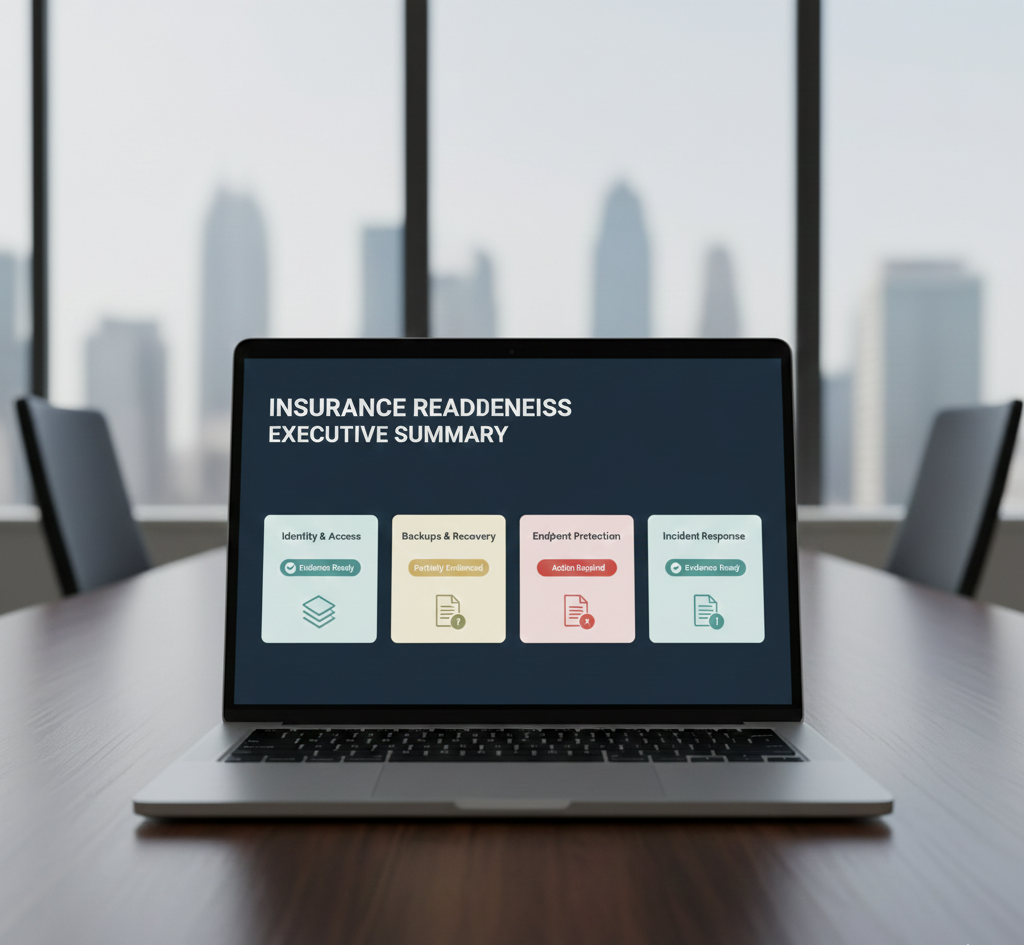
- 03Insurance Readiness Summary for executives and brokers
Most providers optimise for frameworks. Cyberion optimises for the renewal.
A side-by-side of what typical security engagements produce versus what helps during renewal.
Typical vendor Framework-led, generalist, multi-phase | Cyberion Insurer-aligned, evidence-disciplined, fixed-scope |
|---|---|
| Framework-led reports (NIST, ISO, Essential 8 scoring) | Insurer-aligned responses, mapped to the underwriter's questions |
| Maturity scores and high-level recommendations | Evidence pack — screenshots, exports, configs, policy references |
| Open-ended program with multiple phases | Fixed scope, time-bound around the renewal or placement event |
| Tool implementation or managed services upsell | Tool-agnostic. No resale, no platform lock-in |
| Maturity uplift measured over quarters | Practical readiness uplift measured in 1–2 weeks |
| Attestation, certification, or audit claims | Non-attestation. No certification. No coverage guarantees |
Tracked changes — questionnaire answer
Q.04Is multi-factor authentication enforced across the business?
Removed — too vague
MFA is used where appropriate.
Added — defensible & verifiable
MFA is enforced for email, remote access, and privileged accounts, with exceptions listed separately.
evidence: mfa-policy.pdf · admin-export.csv
The value isn’t a larger report. It’s better renewal material: clearer evidence, cleaner wording, and fewer claims that need to be walked back later.
No inflated case studies. Just work you can inspect.
A focused practice means the person scoping your work is the person doing it. Here is how you can judge the quality before committing — not after.
See the work before you commit
Every engagement produces the same artefacts — control mapping, a referenced evidence pack, and a broker-ready summary. You can review a redacted sample before you sign anything.
View a sample deliverablePrincipal-led, both sides of the table
A practitioner who assesses your controls the way an underwriter will read them — knowing what gets verified, what gets penalised, and where answers trigger exclusions. You work with that person directly.
How the engagement runsFixed scope. Fixed fee. 1–2 weeks.
No open-ended program and no surprise invoices. The scope, the price, and the timeline are agreed up front and tied to your renewal date.
Confirm fit on a callOne practitioner, fluent in both security and underwriting.
Most providers know security or insurance — rarely both. The whole value here is reading your controls the way the person pricing your policy will.
- Hands-on with the controls underwriters actually assess — MFA, backups, EDR, privileged access
- Fluent in how a submission is read and priced, and where wording quietly triggers exclusions
- Direct, principal-led delivery on every engagement — the person scoping the work does the work
Scope guarantee. We agree the deliverables in writing before we start. If the evidence pack isn’t complete to that scope by the agreed date, we keep working at no extra cost.
Renewal is the deadline. Staying ready is the advantage.
Most submissions scramble because the evidence was assembled once, under pressure. Some clients ask us to stay on lightly between renewals — keeping evidence current and answers consistent, so next year is a review, not a rebuild.
Where this can go
- Evidence kept renewal-current, not rebuilt each year
- A standing point of contact for broker and insurer questions
- Light-touch advisory as your controls and risk profile change
Optional, and only if it earns its place. Most engagements start and end at the renewal.
Prepare for renewal with insurer-ready evidence
If renewal is approaching, a short call confirms fit — and what evidence you’ll want ready before the questionnaire lands.
Non-attestation engagement. No certification. No tool resale. Just clearer, supportable answers under scrutiny.
The questions you’ll get internally.
And from brokers, finance, or insurers when they read your submission.
- Q.01
Will this guarantee approval or reduce premiums?
- No. Underwriting outcomes depend on the insurer and your risk profile. Our role is to materially improve clarity, reduce avoidable red flags, and strengthen the evidence you can present.
- Q.02
How is “Done With You” different from a normal assessment?
- A normal assessment often ends with a report. Done With You focuses on producing insurer-friendly evidence and helping you complete questionnaires accurately.
- Q.03
What evidence do insurers usually accept?
- Screenshots, exports, policies, logs, backup reports, MFA configs, and similar artefacts — organised against the questionnaire so an underwriter can verify each control quickly.